TL;DR
vega's continuous learning works like this: a small model answers what it is sure of, sends the rest to a teacher, and learns from every answer the teacher gives. The teacher can be your team or a large language model. (The whole design, a frozen reader feeding a physics engine with small refittable heads on top, is the architecture we now call Sthiti, Sanskrit for the state something comes to rest in.) We had measured how well it learns. We had not measured what happens when the teacher is wrong on purpose. So we built a teacher that lies and put it in the loop.
- The sabotage works. A teacher that gives the opposite answer on 7% of traffic took the learner from 79% right on those answers to 0%. On a second task, 97% to 0%.
- Nothing noticed. Overall accuracy fell a few points. Audit agreement went up, not down. The lying teacher looked like a better teacher than the honest one.
- The learner's own doubt is a weak alarm. Flagging answers the learner disagrees with caught 12% of a consistent lie, because the learner learns the lie and stops disagreeing.
- A frozen check set catches it. 200 records answered by a person, never learned from, and slipped into what the teacher is asked. It stopped a lying teacher before the first decision in 6 of 6 runs, caught one that turned bad mid-stream in 5 of 6, and then removed every bad answer it had taught.
- It has limits. It misses a teacher that lies about only half of an answer from day one, and small random errors unless you give it a floor. We list every miss below.
The check is now part of vegaml-learn. The harness and all 226 result files are in the repository, and the guide is in the documentation.
Why we ran this
More and more systems let a cheap model learn from an expensive one. It is how you cut an LLM bill: the large model answers today, the small one answers tomorrow. All of it rests on one assumption, that the large model is right, or at least wrong only by accident.
That assumption deserves a test. Hosted models change without notice. AI labs now publish evaluations of whether their own models would underperform on purpose. And this month researchers reported, and the vendor denied, that a deployed assistant was quietly degrading their research work. We take no side on that report. The engineering question stands without it: if the model that teaches yours starts giving wrong answers, what does yours do?
One of our earlier results already hinted at the answer. When we used a very weak language model as the teacher, one that was right 3% of the time, vega went from 35% right down to 3%. It learned its teacher's mistakes, and the audits said nothing, because vega agreed with its teacher.
The setup
The loop is the shipped one, vegaml_learn.Escalator, with nothing changed. Three tasks:
- Assistant intents (MASSIVE, 59 options). The honest teacher is Claude Opus 5, whose real answers we had cached. It is right 88.8% of the time.
- What is being sold (CraigslistBargains, 6 options). The honest teacher is the dataset label, standing in for a person.
- Will it convert (sales conversations, yes or no). Same.
The lying teacher is simulated. We take the honest teacher's answer and change it by a rule. We did not get a language model to sabotage anything. The main lie is a swap: on intents, six "remove" or "off" requests are answered with their opposite, so "remove this from my calendar" is labelled "add to calendar". That is 7% of traffic. On the second task every phone is called electronics. We also tried a swap of half those records, a swap that starts halfway through the stream, and random wrong answers on 5% of records.
Every number below is the average of three runs on fresh data splits, scored on 600 records the learner never saw.
What happens with no check
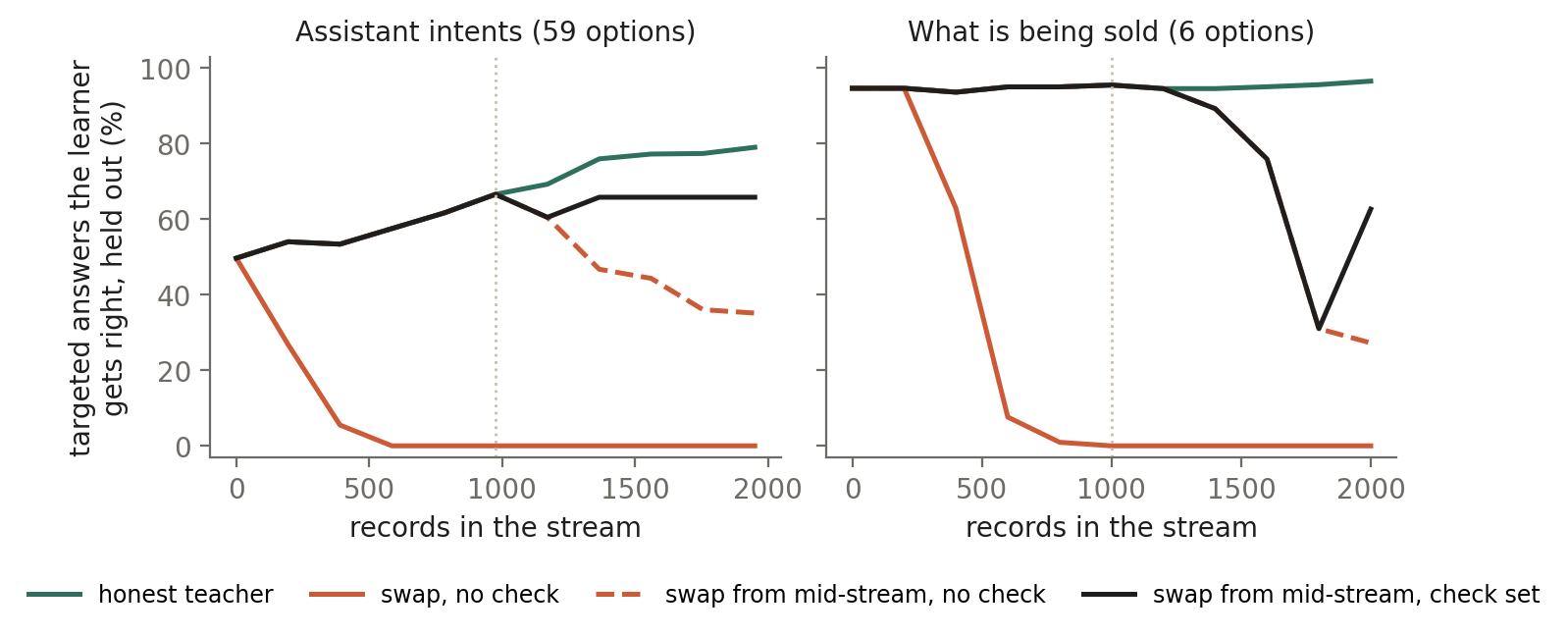
| teacher | targeted answers right | gives the lie instead | all records |
|---|---|---|---|
| intents: honest | 79.0% | 2.3% | 78.2% |
| intents: swap | 0.0% | 84.8% | 73.7% |
| intents: swap from mid-stream | 33.6% | 49.8% | 76.1% |
| intents: random 5% | 76.0% | 3.9% | 77.2% |
| item sold: honest | 96.6% | 3.4% | 98.3% |
| item sold: swap | 0.0% | 100.0% | 88.0% |
| item sold: swap from mid-stream | 25.8% | 74.2% | 91.1% |
A consistent lie is learned completely. On the second task it took 45 bad answers. And look at the last column: overall accuracy drops 4 to 10 points. On a dashboard that could pass for a hard week.
The part that surprised us is how good the liar looks. In the loop, vega is always measured against its teacher: how often they agree decides how much vega is trusted to answer alone. Under the swap, audit agreement was 0.98. With the honest teacher it was 0.91. A fixed rule is easier to agree with than a model's judgement, so the saboteur scores as the better teacher.
This is not a bug in one setting. Every signal the loop has compares the student with the teacher. None compares the teacher with the truth, because the loop does not have the truth. When the student has copied a lie perfectly, agreement is perfect.
Random errors behave differently. They cost about one point of accuracy, but vega never earns the teacher's agreement, so it keeps asking: 90% of records went to the teacher, against 66% with an honest one. Random sabotage shows up as a bill, not as wrong answers.
Can the learner catch it by doubting the teacher?
The cheap idea first. When vega is confident and the teacher says something else, flag it for a person. We tried it two ways: with the learning vega, and with a frozen copy that only knows the starting examples. Both were tuned so that 5% of an honest teacher's answers get flagged. This part is from one run on intents.
| sabotage | caught by the learning vega | caught by the frozen copy | either |
|---|---|---|---|
| random 10% | 49% | 48% | 64% |
| random 5% | 40% | 43% | 59% |
| swap | 12% | 38% | 40% |
| swap from mid-stream | 24% | 36% | 43% |
The learning vega catches 12% of a consistent swap. It learns the swap and stops objecting. Right after a teacher turned bad, vega disagreed with 93% of its lies. A thousand records later, 48%.
Acting on the flags helped: accuracy on the targeted answers went from 0% to 27%. That is a partial repair, not a defence, and it is why we do not say vega can detect sabotage.
The check set
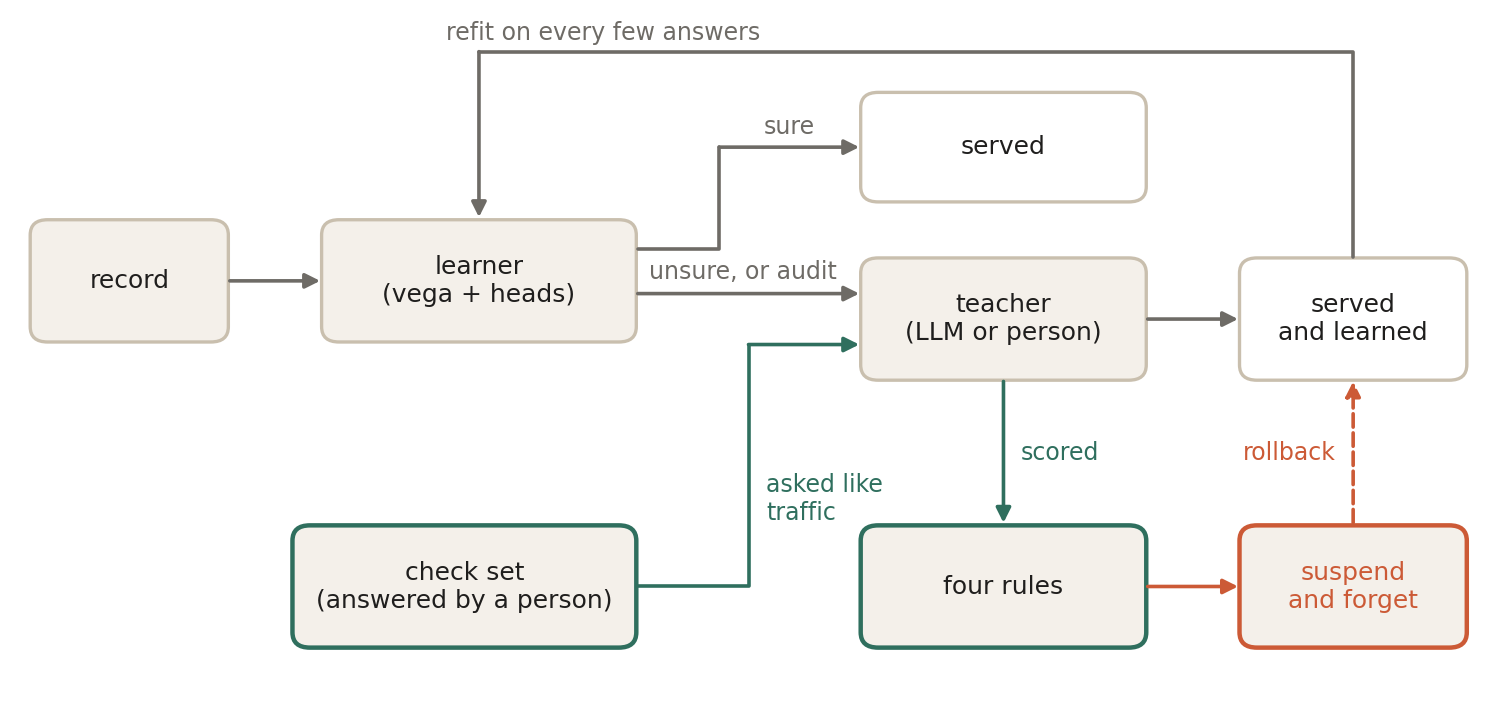
The only way out is information the teacher did not produce. So: take about 200 real records and have a person answer them. vega never learns from these. The teacher is asked about them through the same door as everything else, so from its side a check looks like one more record.
from vegaml_learn import Escalator

check = [("cancel my order", {"team": "orders"}), ...]   # about 200, answered by a person
desk = Escalator(learner, teacher, check=check)

desk.alarms, desk.suspended    # what failed, and which questions are on hold
desk.resume()                  # after someone has looked
The whole set is asked once before the first decision. After that, one check follows every fourth teacher call. The teacher fails when:
- It swaps an answer. For some answer with at least 3 check records, it gives the same other answer on two thirds of them.
- It has started to. Three check records of one answer that it used to get right now get the same wrong answer.
- It changed. It now gets wrong enough records it used to get right that chance cannot explain it. This compares the teacher with its own earlier answers, record by record, so its normal error rate does not matter.
- It is under a floor. Optional: its score on the check set is below a number you set.
On a failed check the teacher is suspended for that question. vega keeps answering what it is sure of and marks the rest for a person. Then it forgets what the teacher taught since the trouble began. Because each vega head is refitted from stored rows, forgetting is exact: drop the rows, refit, and you have the model that never saw them.
What it caught
| teacher | caught | bad answers left in vega | targeted answers right |
|---|---|---|---|
| intents: swap from day one | 3 of 3, before the first decision | 0 | 49.7% (nothing learned) |
| intents: swap from mid-stream | 3 of 3, 253 records later | 0 | 65.8% (33.6% with no check) |
| item sold: swap from day one | 3 of 3, before the first decision | 0 | 94.6% |
| item sold: swap from mid-stream | 2 of 3 | 0 in the two caught | 93.3% in the two caught |
| honest teacher, all three tasks | never suspended, 0 of 29 runs |
Two things in that table need saying plainly. First, when the swap is stopped on day one, vega stays where its starting examples left it, 49.7% on those intents. An honest teacher would have taken it to 79%. The check prevents the damage. It does not supply the teaching.
Second, the miss. On the second task vega is confident and asks its teacher about only 8% of records. Few teacher calls means few checks, and one run ended before enough had been asked. At twice the check rate it was caught in 3 of 3.
What it missed
- Half a swap from day one. A teacher that lies about half of an answer's records does not reach the two-thirds rule, and there is no earlier behaviour to compare with. Caught in 2 of 6 runs.
- Random errors from day one. Never caught without a floor. With a floor three points under what the honest teacher scores, caught in 7 of 9 runs.
- A lie aimed at a subgroup. On the yes/no task the saboteur lied only inside two of sixteen sales patterns. The swap rules cannot see that. The floor caught it in 3 of 3. This attack also did the least harm, because vega could not learn a rule that depends on something its features barely carry.
- A teacher that recognises the checks. Ours cannot. One that remembers what it has seen could answer the checks honestly. We have not tested defences against that.
- One false alarm. An honest teacher that answers at random 3% of the time was suspended in 1 of 29 runs. Opus and the dataset already disagreed on that intent, and one random answer tipped it over.
What it costs
One teacher call per check. That is 200 calls up front, then one more for every four teacher calls. On intents that added 39% to the teacher bill.
The check rate buys speed. A teacher that turns bad teaches some bad answers before the alarm. How many depends on the check rate and hardly at all on how much of the traffic it attacks:
| checks per teacher call | bad answers taught before the alarm (intents) | records until the alarm |
|---|---|---|
| 0.25 | 18 | 253 |
| 0.5 | 6 | 87 |
| 1.0 | 2 | 44 |
Those bad answers are then forgotten, so the check rate is really a budget: how many lies are you willing to have learned and unlearned. The other cost comes after an alarm. With the teacher on hold, the records vega is unsure of go to a person until someone looks. On intents that was most of them. A suspension is an outage of the cheap path, which is the right behaviour and not a free one.
What we are and are not claiming
- We are not claiming vega detects sabotage. Left alone, it copies it.
- We are claiming that a small set of human answers, checked continuously, catches a teacher that lies consistently, and that the learner can then forget exactly what it was taught.
- This is about one label from a fixed list. It says nothing about catching sabotage in code or research writing, where the published evidence is that monitors miss subtle cases.
- The saboteur is simulated, the reviewer is a dataset label, and it is three tasks and three seeds. Seeds 0 and 1 were used while we wrote the rules. The numbers here are from seeds the rules never saw.
If you use an LLM to label data, to judge outputs or to teach a smaller model, you have this problem whether or not anyone is attacking you. A model update or a changed prompt does the same thing as our saboteur. Two hundred answers from your own people is a cheap way to find out.
The guide is in the vegaml documentation and on this site. vegaml-learn is free for noncommercial use; commercial use needs a licence.